Why Waves and Light Matter More Than Parents Think
Let's be real — waves and light can look like one of those O-Level Physics chapters that is full of definitions, strange diagrams and memorisation traps. Many parents see terms like wavelength, refraction and critical angle, then assume their child either “gets it” or does not. But here's the thing: this topic becomes much easier once the patterns are clear.
That matters because waves and light are not isolated facts. They train students to read diagrams carefully, use formulas properly and explain physical ideas with precision. Those are the same skills that help across the wider O-Level Sciences and other science chapters.
The truth is, many students lose marks here not because the chapter is impossible, but because they mix up terms that sound similar. Amplitude and wavelength. Pitch and loudness. Reflection and refraction. A small confusion early on can snowball into bigger mistakes during timed practice.
The good news is that this chapter is very teachable. Once students understand what each idea actually means, their answers become more confident and much more accurate.
The Big Idea Behind Waves
A wave transfers energy from one place to another without transferring matter along the whole distance. That one sentence clears up a lot of confusion.
Think of a ripple moving across water. The disturbance travels, but the water itself does not move all the way across the pond with the ripple. In Physics terms, students need to separate the movement of the wave from the movement of the medium.
Here are the core terms your child needs to know:
- Amplitude: the maximum displacement from the rest position
- Wavelength: the distance between two corresponding points on successive waves
- Frequency: the number of complete waves produced each second
- Period: the time taken for one complete wave
- Wave speed: how fast the wave travels
The main formula connecting these ideas is:
TB_MATH_BLOCK_0
where is wave speed, is frequency and is wavelength.
Students often memorise this formula but do not stop to interpret it. A higher frequency means more waves each second. A longer wavelength means each wave takes up more distance. Together, those two factors determine how quickly the wave travels.
Tip: Ask your child to explain each symbol in words before doing any calculation. Memorising the formula without understanding the variables is exactly why careless mistakes happen in exams.
Transverse and Longitudinal Waves Without the Usual Confusion
Students are usually expected to distinguish between two main types of waves.
In a transverse wave, the vibrations are perpendicular to the direction of energy transfer. Light is the standard example. Students see crests and troughs in diagrams, which makes the idea easier to picture.
In a longitudinal wave, the vibrations are parallel to the direction of energy transfer. Sound is the key example here. Instead of crests and troughs, students need to recognise compressions and rarefactions.
A common mistake is assuming all waves can be drawn the same way. They cannot. That sketch with peaks and dips is useful for showing wave behaviour, but it does not mean sound literally travels as a wavy line through the air.
That is why clear diagrams matter so much. When students can identify the type of wave first, the rest of the question usually becomes more manageable.
Sound Waves: Where the Mix-Ups Start
Sound is produced by a vibrating source and needs a medium to travel through. That means sound cannot travel through a vacuum. Light can, but sound cannot. This one comparison comes up again and again.
Students also need to separate two linked but different ideas:
- Loudness depends on amplitude
- Pitch depends on frequency
This sounds simple on paper, but under pressure many students swap them around. They see a “bigger wave” and immediately think “higher pitch”, when the correct idea might be “louder sound”.
Echo questions can also catch students out. An echo happens when sound reflects off a surface and returns to the listener. If the distance and time are given, students must remember that the sound has travelled to the surface and back, not just one way.
Ultrasound is another useful example because it shows real-world application. It can be used in medical imaging and other detection tasks because high-frequency sound waves can reflect from internal boundaries and produce useful information.
Making Sense of the Electromagnetic Spectrum
The electromagnetic spectrum often feels like a memorisation list, but there is more structure than students realise.
The regions are usually arranged from lower frequency and longer wavelength to higher frequency and shorter wavelength. Students should know the order and some common uses. They should also understand that all electromagnetic waves travel through a vacuum.
What often helps is tying each region to a practical image:
- Radio waves for communication
- Microwaves for cooking and communication
- Infrared for heat-related uses
- Visible light for sight
- Ultraviolet for sterilisation and fluorescent effects
- X-rays for medical imaging
- Gamma rays for treatment and sterilisation
The trap is memorising uses without learning the risks. Higher-energy parts of the spectrum can damage living tissue if exposure is excessive. Students should be able to match both a use and a hazard to the correct region.
This is also where broader science revision helps. When students are juggling several content-heavy topics at once, a structured revision plan matters just as much as subject knowledge. Articles like Study Techniques can help parents guide that process more effectively.
Reflection and Refraction: The Core Light Ideas
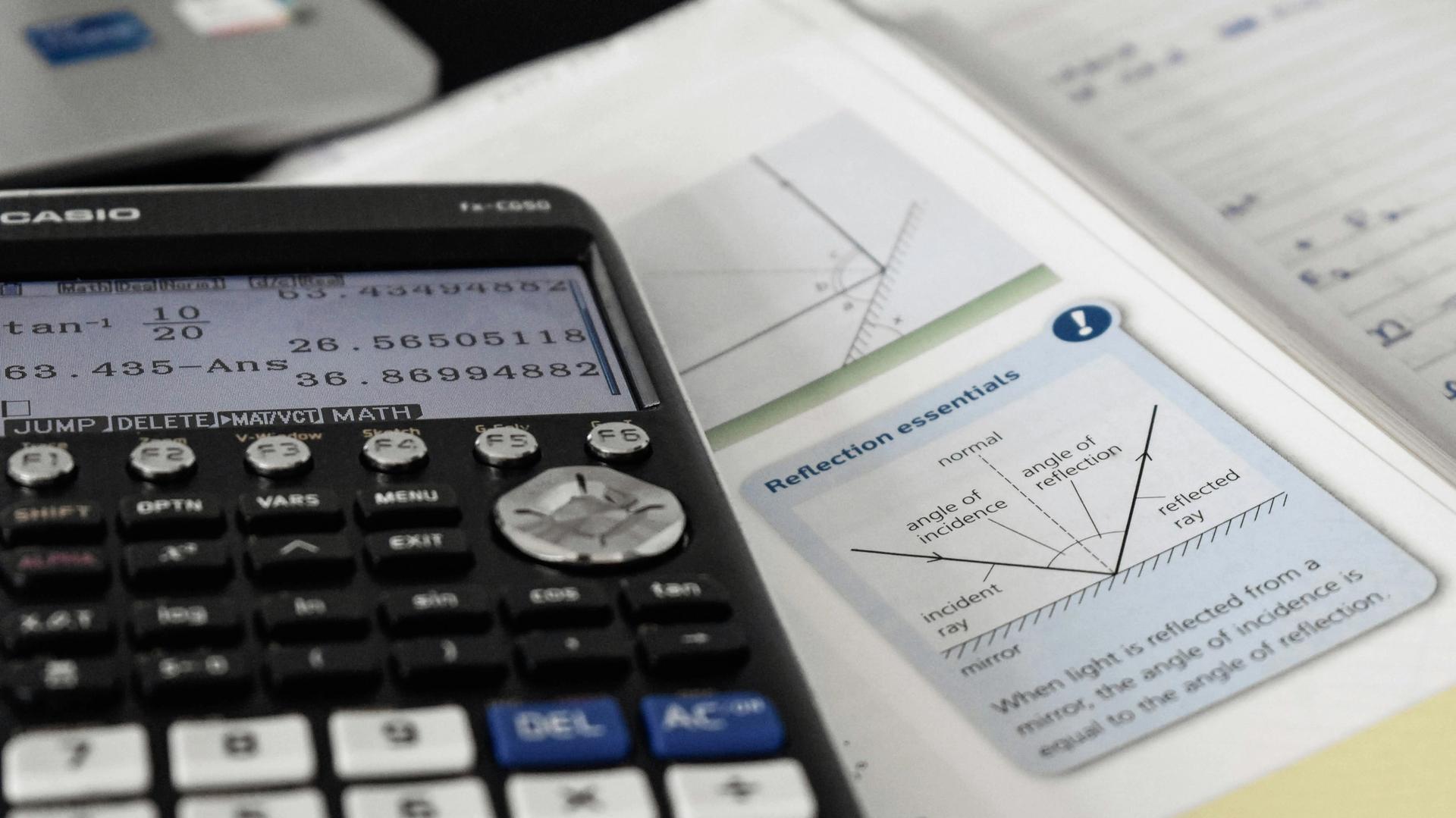
Reflection is usually the easier of the two. When light reflects from a plane mirror, the angle of incidence equals the angle of reflection. Students must measure both angles from the normal, not from the surface itself.
That sounds basic, but it is one of the most common diagram mistakes in school work.
Refraction is harder because students must explain why the ray bends. Light changes speed when it moves from one medium to another. If it enters a more optically dense medium, it slows down and bends towards the normal. If it moves into a less optically dense medium, it speeds up and bends away from the normal.
Students may also meet refractive index in a simple mathematical form:
where is the angle of incidence and is the angle of refraction for a given pair of media.
The key is not turning this into blind substitution practice. Your child should be able to look at a ray diagram and predict the direction of bending before touching the calculator. If they cannot do that, the formula work is not really secure yet.
Total Internal Reflection and Optical Fibres
Total internal reflection sounds intimidating, but the condition is quite specific. It happens when light travels from a more optically dense medium to a less optically dense medium, and the angle of incidence is greater than the critical angle.
If the angle is exactly the critical angle, the refracted ray travels along the boundary. If it is larger than the critical angle, the light reflects fully back into the denser medium.
This matters because it explains how optical fibres work. Light can be guided along the fibre by repeated total internal reflection, which makes fast communication possible over long distances. It also explains some medical instruments that rely on fibre optics.
For many students, this topic clicks only after they sketch a few ray paths by hand. Reading the definition alone is rarely enough.
Thin Converging Lenses and Ray Diagrams
Lenses are another area where weak diagram habits cost marks. A converging lens brings parallel rays together at the principal focus. Students need to know the principal axis, optical centre and focal length, then use standard rays to locate images.
The three common rays are:
- A ray parallel to the principal axis refracts through the principal focus
- A ray through the optical centre continues undeviated
- A ray through the principal focus emerges parallel to the principal axis
Once students can draw at least two of these correctly, they can work out whether the image is real or virtual, upright or inverted, enlarged or diminished.
This is where Physics topics connect nicely. The same careful step-by-step thinking used in ray diagrams also helps with graph reading, variable tracking and formula work in chapters like O-Level Physics Kinematics: Motion Made Simple. If your child rushes diagrams in one chapter, the same habit usually shows up elsewhere too.
Tip: Do not let your child “visualise” lens questions without drawing. In exams, guessing image position from memory is risky. A quick, accurate sketch is usually safer.
The Mistakes That Keep Pulling Marks Down
Most lost marks in waves and light come from a short list of repeat errors:
- confusing amplitude with wavelength
- mixing up pitch and loudness
- measuring angles from the surface instead of the normal
- forgetting that sound needs a medium
- using the correct formula with the wrong unit or wrong variable
- describing total internal reflection without stating the required conditions
- guessing lens images instead of drawing them
Sound familiar? You are not alone in this. These are common because the topic mixes vocabulary, diagrams and calculations all at once.
It also helps to remember that students are balancing more than one science subject at the same time. If revision starts to feel messy across the board, it may help to compare how they are coping in related chapters such as O-Level Biology: Human Body Systems Guide. Sometimes the issue is not just Physics content. It is revision overload.
How Parents Can Support Revision Without Adding More Stress
Parents do not need to reteach the whole chapter to be useful. What helps most is creating a simple system.
Start with these:
- ask your child to define key terms out loud in plain English
- make sure they can rearrange and use
- get them to redraw reflection, refraction and lens diagrams from memory
- use flashcards for spectrum uses and hazards
- do timed practice on short structured questions, not only full papers
Here's what actually works: short, repeated practice beats one long panic session. A 20-minute review of wave terms and one or two ray diagrams done properly will usually help more than an hour of passive reading.
But honestly, if your child keeps memorising without understanding, progress will stall. They may appear prepared, then freeze when the question is phrased differently.
When Extra Help Makes Sense
If your child understands the chapter in class but still cannot explain it clearly on their own, that is often the point where support makes a real difference. Waves and light is manageable, but it rewards guided correction. One small misconception can keep repeating until prelims.
The good news is that support does not have to mean more pressure at home. Sometimes a patient explanation, targeted practice and regular feedback are enough to rebuild confidence.
You can also explore broader O-Level support through O-Level Complete Guide if your child is struggling across several subjects, not just Physics.
And if you want more personalised help,
Ready to find the right tutor for your child? Our matching service connects you with experienced tutors who fit your specific needs.
can help you submit your request, get matched, and connect with a tutor who fits your child's needs.
Get Matched with a Tutor in 24 Hours
Join 5,000+ families who found their perfect tutor through TutorBee. No agency fees, 100% verified tutors.
Related Articles

O-Level Chinese: Composition and Oral Tips
O-Level Chinese composition and oral tips help students prepare with more confidence. Learn practical ways to improve writing, speaking, and exam focus.

Mind Mapping: A Visual Study Tool
A mind mapping study tool helps your child turn messy notes into clear revision paths. Learn when it works best and how to use it without wasting time.

SEAB GCE O-Level History syllabus and specimen materials
O-Level history essay writing tips for students and parents: learn how to answer directly, structure paragraphs, and improve elective History marks well.